I. The starting situation
VOLUME 1. Mobilizing the Self · Part 1. Orienting the Self
The first half of this book invites you to invade your own privacy, and it offers a technique for doing this which many before you have found workable. What may be accomplished by such a venture is a question which you will ask at once, but the answer cannot be delivered in a neat verbal package. As a matter of fact, a crucial part of the answer is non verbal and must remain such; if you are to obtain it, it will have to come from doing work of the sort set forth here. But since we cannot expect you to initiate what appears to be a time-consuming and probably difficult course of action simply in the blind faith that it will in the end prove worth the trouble, we endeavor in the remarks which follow to present something of the general human situation as we see it and our grounds for believing that we have something important to share with anyone who genuinely wants to improve his lot.
What we propose to help you do for yourself cannot but smack at first of the blandishments and unctuous phrasings that have been used to hawk Messianic literary wares, for, baldly stated, it is this: to assist you to discover your self and to mobilize it for greater effectiveness in satisfying your requirements both as a biological organism and as a social human being.
Self-discovery may sound like “old stuff’’—one more futile muttering of the “lift-yourself-by-your-own-bootstraps” school of thought—but, as we employ the term, self-discovery is an arduous process. Far from being a sudden flash of revelation, it is more or less continuous and cumulative—and need never end so long as one is alive. It involves the adoption of a rather special attitude toward your self and observation of your self in action. To observe your self in action—ultimately, to observe your self as action—calls for techniques strikingly different from those you may have tried already and found wanting; in particular, introspection.
If self-discovery sounds not unavailing but ominous, we shall not contest this reaction, however reminiscent of the psychiatric mumbo-jumbo of the movies. To suppose that you do have a secret or hidden self but that it is sinister and better left alone is an attitude you have not always had and need not retain indefinitely. It comes from your having in the past in time of stress rejected parts of your self that were causing too much trouble. As the circumstances then were, these parts were sinister and, to live on in the situation which then existed, you had to get rid of them. Perhaps it was something like the predicament of a wild animal caught in a trap by one leg; under such conditions the leg becomes a menace, and the animal will sometimes gnaw it off and thereby escape, though he spend the rest of his life a cripple.
Your life as it now stands is far different from what it was when you rejected part of your self, and this cast-out part, unlike the animal’s leg, can perhaps now be salvaged. Whether the original grounds for rejection still hold or have now long since disappeared would seem, at the very least, to merit your investigation. In what is to follow we supply a method by which you may conduct a systematic examination and reconstruction of your present situation. The procedure is arranged so that each step lays the necessary groundwork for the next. How much of the task you can accomplish within a stated interval depends both on how much of your self you have cast out and on what you are at present up against in your life-situation. You will set your own pace. In any event, you will not go one step faster or further than you wish to.
We have in store for you no “easy steps to mastery,” no moral uplift program, no guaranteed rules for breaking bad habits which you are actually determined to keep. We undertake to do nothing to you. Instead, we state some instructions by means of which, if you so desire, you may launch yourself on a progressive personal adventure wherein, by your own active efforts, you may do something for your self—namely, discover it, organize it and put it to constructive use in the living of your life.
Paradoxes in the above statements we leave until later. For the moment let us merely say that, in separating “your” and “self” instead of saying “yourself,” we have not wished to plague the proof-reader in you but to emphasize the possessiveness of the possessive pronoun “your.” It is your self. Also, please note in passing that the “you” we speak of—the “you” that must do any discovering that is done—is at one and the same time obviously a part of “your self.” It is the part that is accessible to us as we address you now. It is the part that is subvocally repeating these words as it reads them.
No suggestion is made that this undertaking will be easy. The directions as stated may appear easy—so easy, in fact, that it is quite possible for you to claim to the end that there is nothing to them. You may breeze through, get no results you did not foresee, and call it a day. If, on the other hand, you contact a bit more closely the experimental situations which you will set up, you will find that, in a peculiar way, they present the hardest, the most exasperating work you have ever tackled—but also, if you follow through, the most fascinating.
In these pages we try to talk to you as if we were face to face. Of course, you do not, as in ordinary conversation, have a chance to take the floor, talk back, ask questions, or supply precise details about your personal situation; and we, on the other hand, have the disadvantage of not knowing you personally. If we did know particulars about you—your age, sex, schooling, work, or your successes, failures, plans, fears,—then, while this would not change in any fundamental way what we wish to communicate, we could add or delete, change emphasis here and there, put things in different sequence, and perhaps effect short-cuts on the basis of such information. Nevertheless, we believe that practically everything we shall deal with is applicable, in some degree or in some respect, to every human being living in our times under the conditions of Western civilization. For you to make whatever application is appropriate to your personal situation constitutes your work in this joint undertaking.
Since many of our views on the manner in which the self functions differ from currently accepted notions of human nature, it is important to realize that what we present is not something “dreamed up” overnight, but is, rather, the fusion of several lines of approach to the problem of the human personality. To make this clear, we must say something about the present status of the science of psychology.
Psychologists—and by this term we mean all those who conduct systematic investigations directed at the understanding of human behavior—may be roughly divided into two groups. The members of one group take pride in following what has traditionally been called the “experimental approach,” while the others, regardless of their various self-christenings, are regarded—particularly by the experimentalists—as following the “clinical approach.” Common to both is the basic problem of understanding human behavior, but, because of divergent assumptions on how to go about the job, they have until recently had relatively independent development1.
Toward the end of the Nineteenth Century, when psychology was separating from philosophy and attempting to establish itself as a science, its leaders were eager to be accepted as true scientists. Accordingly, they did their best to copy in their own field the same methods which had won prestige for the older and more advanced science of physics. To correspond with the physicist’s atom as the most elementary unit of matter, these early psychologists endeavored to identify “atoms” of behavior—that is, irreducible elements of human activity which might serve as building-blocks for more complicated reactions. They tried to do this by employing as nearly as possible those methods of experimental analysis which were used in physics. By present standards these early efforts were crude, but, despite increased sophistication, present-day experimentalists still tend to be ultra-conservative in the selection of problems upon which to do research. Since they are fearful of turning up data not at once countable or measurable by techniques already at hand, they have relatively little to contribute as yet to such full-scale human problems as emotion and personality. Psychology, they say, needs perhaps another fifty or a hundred years of development before it can deal adequately with such complicated matters.
A little later we shall have to come back to the position taken by the experimentalist, particularly because of its bearing on the problem of proof. As you work along with us, you will be inclined from time to time to question statements that we make, and you will demand, “Where is your proof?” Our standard answer will be that we present nothing that you cannot verify for yourself in terms of your own behavior, but, if your psychological make-up is that of the experimentalist as we have portrayed him, this will not satisfy you and you will clamor for “objective evidence” of a verbal sort, prior to trying out a single non-verbal step of the procedure.
Failure to provide proof for their theories is the heaviest charge laid at the door of those who follow the “clinical approach.” The clinician, unlike the experimentalist in his laboratory, was forced from the beginning to deal in some fashion with the full complexity of human behavior, for his work was that of attempting to heal, and his patients lacked the grace to bring him simple problems. While the human urgency of his cases kept him centered on emotional crises of living and protected the vital level of his work from sinking ever to the depths of what may be performed in the name of experimental science—namely, to grub away at safe tasks for the sake of adding items to one’s list of publications—nevertheless, the clinician was swamped by the very richness and profusion of his case material. Usually pressed for time, inured by necessity to playing hunches, often unaware or contemptuous of the experimentalist’s passion for verification, he spun theories which were bizarre blendings of keen insight and ungrounded speculation. Nonetheless, his work has been so fruitful that it carries the present potential of freeing the species from man’s age-long distortion of man.
Because of differences in temperament, training and objectives, experimentalist and clinician have viewed each other with mutual distrust. To the experimentalist the clinician has seemed, as a scientist, an untamed wild man, careening drunkenly through areas of theory and practice; while to the clinician the experimentalist has appeared an untreated obsessional, miserably bound to his counting mania and, in the name of pure science, learning more and more about less and less. Recently, as they have converged on problems of mutual interest, they have manifested increased respect for each other and their sharper differences are being resolved.
We must go to the core of the issue between experimentalists and clinicians, for this is not just a family quarrel within psychology but one which reflects the selfsame division in beliefs and attitudes which exists in some degree within the personality of everyone reared in our society. Since the self-development procedures which we shall present constitute an informal but genuine joining of experimental technique to a clinical type of material, it is essential that we be clear about what we are doing. We must, for instance, face the fact that we blandly commit what to the experimentalist is the most unpardonable of sins: we include the experimenter in the experiment!2 To justify anything so preposterous, we must now consider further the fact that experimentalist and clinician alike are seeking, each with his own standards of rigor and workability, an understanding of human behavior. Let us examine their respective positions more closely and the extent to which their views and methods overlap, for it is in this area that we shall do our work.
In a court of law the ordinary witness is permitted to give testimony only with respect to what he has seen, heard, or otherwise directly experienced. He is denied the privilege of stating any inferences or conclusions which he may have drawn from such experience, for, in the eyes of the court, his “opinions” are “irrelevant, immaterial, and incompetent.” The expert witness, on the other hand, is allowed to offer as testimony his opinions on those aspects of the case which lie within the area of his special competence. Unfortunately, the trial may then degenerate into a battle of opposed experts.
A similar situation develops when human beings are asked to report on their own psychological processes. These reports differ widely from person to person, and there is no way of checking on which of them, if any, is correct. As a result, the experimentalist has long since outdone the courts in excluding unreliable testimony, and for him there exists no acceptable expert witness of events which are private. It follows inevitably, of course, that in excluding the single witness who is in a position to report on them, he also thereby excludes from his science all concern with private events as such.
In his continuous stress on psychology’s need to be objective and to banish eternally from the realm of science whatever is subjective, the experimentalist says, in effect, that whatever can be placed publicly on display for inspection by competent observers is admissible as scientific data; whatever is by its nature limited to a private showing, while it may outside of working hours be granted to exist, cannot be acceptable as part of the stuff of science because of its inaccessibility to other observers for confirmation. In the older terminology, what may be pointed to in the “external world” in such fashion that others may come and view it and say yea deserves our confidence, whereas what one reports as being “in his mind” is wholly untrustworthy.
Such a dichotomy between public and private has much to commend it, for the fallibility of testimony is notorious. The clinician, by a curious turn, is here in stride with the experimentalist, for, although he listens endlessly to what his patient has to say, he declines to take it at face value. The patient in his view is utterly incapable of telling a straight story, even to himself. To his own vocalizations the doctor may, perhaps, be a bit more likely to accord a clean bill of health.
The experimentalist’s conviction that in public display there is safety—or, at any rate, less risk—is, to be sure, not his exclusively. In all undertakings where much is at stake and where effort is expended to establish fact securely or to make binding for the future such formal commitments as promises, confessions, or depositions, we see the insistence upon signatures, attestations, multiple records, affixing of seals, and so on—to the extent that it provides a livelihood for notaries public. One says to a friend, “Whatever you do, don’t put it in writing,” or, if it is the friend who is trying to hold someone to something, this changes to, “Make them give it to you in black and white.” When such mistrust is rampant and even rational in everyday transactions, why should the scientist be immune?
Experimentalists subscribe to this further safeguard: an investigator must publish his findings with such detailed specification of apparatus, steps of procedure, and so on, that any competent fellow investigator, dubious of his conclusions, may repeat the study. Though this is seldom done and, in many instances might be impracticable, nevertheless such a proviso presumably has combated temptation to “cook the data” for more positive results. In contrast to such formality in making public the conditions under which an experiment has been performed and which, if reestablished, make feasible its redoing, consider how impossible it is to stipulate conditions under which the deliverances of private “minds” might be subject to recheck.
Restriction of studies to situations capable of being reproduced constitutes a stifling limitation from the point of view of those habituated to thinking of psychology in terms of the nuances of personality. The experimentalist’s reply would be that science can never concern itself with the unique. It seeks rather to specify the circumstances under which a given event may be reliably predicted. Should it become possible to do this in sufficient detail, then prediction changes into control and the event may then be made to occur at will. Those events which are of great complexity may stubbornly remain outside the range of direct control and not pass beyond the stage of somewhat increased accuracy of prediction.
Let it be noted in passing that if the object of study be human beings, then any prediction or control of their behavior in the experimentalist’s sense must be in the hands of someone empowered to act as stage-manager in their theatre of action. For the stagemanager to be a part of the person himself adds nothing except change of locus of the control, and is but a special case under the more general formulation.
Experimentalists who are eager to make the widest practical applications of their findings assert that we are on the brink of an era of “human engineering.” Already this is on an organized basis in such matters as propaganda, public relations, sales promotion, personnel management, and the proclivities of assorted “action groups.” The pity, say the experimentalists, is that such applications so often are not “in the social interest”; but, they add, when a new tool is forged it is not the fault of the tool or the toolmaker if it is misused. The problem is to extend the “human engineering” to the point where it controls the motives of the user of the tool. This implies a hierarchy of controllers of controllers, with much dependent on the top “human engineer.”
With, respect to the individual, he is encouraged to be to an extent his own “human engineer.” By manipulating the situations in which he has found that he is likely or unlikely to come forth with various desired or undesired reactions, he may learn to trigger off or bottle up according to plan. That such devices of “self-control” are perfectly feasible is well shown in the case of the “self-conqueror,” who will come in for discussion later. The darker side of the picture is that this “human engineer” in the personality would have to be one part in charge of the rest, operating it according to what he conceived to be his own best interests, and these, by the very nature of such a set-up, would be, as we shall try to show later, arbitrary and discordant with the animal needs of the species.
The “human engineering” proposals are reminiscent of the Huxleyan “Brave New World.” There, even with the benefits of Utopian technology, it may be remembered that, as a precautionary measure, it was deemed advisable to lock up in a vault the works of Shakespeare and other such inflammatory relics lest the social equilibrium so laboriously attained be set once more awry.
Now let us have a further look at the situation from the standpoint of the clinician. His work, as we said before, has always been concerned with therapy, but we shall not review here the history of psychological healing. (Its practice as an art is as old as civilization, and its methods as varied as man’s ingenuity or folly. We deal only with the modem, highly developed form of psychotherapy wherein doctor and patient time after time confront each other in private and talk. This is the situation we have visualized in speaking of the “clinical approach,” although this does not cover the term’s full range of application.)
The name most frequently connected with interview therapy is, of course, that of Sigmund Freud. Psychoanalysis has since been modified, expanded or variously transformed, particularly by auxiliary techniques which go far beyond what was available in the early years. The orthodox followers of Freud would, if they could, restrict application of the term “psychoanalysis” to their own practice, and have the various offshoots, derivatives, or innovations named otherwise; but control of the term has been irretrievably lost in the welter of loose usage. On the other hand, those groups who believe that their methods have moved so far ahead of what Freud called “psychoanalysis” that this term, applied to their own practice, is an antiquarian misnomer, are in no better plight. The generic appellation, especially in its elided form of “analysis,” has passed into the public domain and may be slow to be sloughed off.
By many “clinical approach” has been regarded as the antithesis of “experimental approach.” It has lacked rigor and quantitative evaluation of results. It has wallowed in “subjective” findings and remained unregenerate when sharply called to task. It has been unruffled by the unreproducibility of its data. It has coined words with abandon and been indifferent to problems of operational definition. In short, while there are now very few indeed who would defend the thesis that the whole psychoanalytical movement has been simply a tremendous hoax, from sundry quarters voices ask, “But is it science?”
The answer, obviously, depends on how one chooses to define “science.” If the term be restricted to what is done under full laboratory rigor, then certainly clinical practice is not science. By the same criterion, however, the designation of “science” would have to be withheld from many other areas of study, notably the social “sciences.” Should this be done, their work would proceed as usual, though at a lower level of prestige.
It is the current prestige of the word “science” that makes this tedious discussion necessary. What is “scientifically established” must be believed, and what is “unscientific” must be distrusted. Even the family doctor, for generations proud to regard himself as “practicing the art of medicine,” gives indication of climbing on the bandwagon with a new self-styling of “medical scientist.”
Psychoanalysis might today enjoy better standing in the scientific family had it made use of that brand of “human engineering” called “public relations.” It would then, perhaps, have been less truculent when attacked, and where it saw a spade and called it such it might, when admonished to be more mannerly, have announced that, on second look, it was, indeed, a shovel. One thing it would never have done upon advice of counsel was to assert that no one who had not himself been psychoanalyzed was in any position to evaluate it with respect to method or theory. Among the protests which this called forth one of the more temperate was to the effect that “it is not necessary to eat the whole egg to tell if it is bad.”
Perhaps we can clarify, although not resolve, this altercation. Petty criticism of psychoanalysis, which expresses nothing but spite or repeats hearsay, we do not attempt to contend with. What we are concerned with is serious, informed criticism, from men of scientific attainment, who have evaluated psychoanalysis as a logical system and found it wanting. First we must ask: from what basis of contact with it do they render judgment? The answer would seem to be that their acquaintance has been with its verbal formulations, notably the writing of Freud, and it is to these verbal formulations that they allude when they apply the term “psychoanalysis.”
On the other hand, when that same term is uttered by those who practice psychoanalysis and those who have encountered it as patients, they are not referring to the writings about psychoanalysis. They speak, instead, of what has over a long period of time become a way of functioning that has modified their whole organism. Their over-all processes of seeing and doing have in varying degree undergone transformation. Correspondingly, what they say on the subject comes from sources which are not themselves exclusively verbal.
This differs in no way from what happens in the behavior of a person who becomes skilled or expert in any specialty. Let us cite the case of the experimentalist reading the formal publication of a study done by a fellow-investigator in a field related to his own. The diagrams or pictures of apparatus, which would stop the novice in his tracks, he readily comprehends. He has handled similar pieces, and has through arduous technical training come to appreciate the necessity for their seemingly over-complicated design. The procedures are clear to him as stated, the results openly displayed, and the conclusions follow in logical order. If, to his practiced eye, nothing is amiss, the experimentalist accepts the new findings and will, if occasion warrants, use them as a jumping-off place for further investigations of his own.
But suppose, to his dismay, the conclusions reported damage a cherished theory of his own. What shall he do? He can go vigorously into print attacking the study which has upset him, exploiting to the utmost whatever talking-points he can ferret out. Or he can— and if he is a confirmed experimentalist he will—disdain the area of verbal polemic and take to his laboratory for a complete rechecking of the troublesome study. This is the only way he can solve his problem. A spate of words directed against the published words of his rival cannot suffice, for those words arose from non-verbal operations—and it is in the validity of those non-verbal operations that the words must find or lose their sanction.
But we must also inspect the other side of the coin. To the extent that psychoanalysts have shrugged off criticism when it came from those who were not members of the esoteric brotherhood, they have defended themselves by a neat but infuriating twist of the wrist that has parried sound criticism together with the rest. But however that may be, recent developments in clinical practice suggest that much that has been controversial can finally be relegated to the past.
We return to the matter previously broached: the assumed antithesis of “experimental” and “clinical.” Putting aside the separate origins of these two approaches, Newtonian physics and the art of healing, let us look again at the actual activities of those engaged in each.
“Experiment” derives from experiri, to try. An experiment is “a trial or special observation made to confirm or disprove something doubtful, esp. one under conditions determined by the experimenter; an act or operation undertaken in order to discover some unknown principle or effect, or to test, establish, or illustrate some suggested or known truth; practical test; proof.”
According to such a definition, interview therapy is experimental. Consider the tremendous control of “variables” introduced by the deliberately simplified setting of the therapeutic situation as compared with the full complexity of everyday living. The doctor and patient are alone in an atmosphere cleared of distractions. The customary admonitions of the clock are in abeyance and, for the duration of the session, time is open for whatever may come to pass. For a period society is diminished to two persons. It is a genuine society, but, for this hour, there is respite from ordinary social pressures, and the customary penalties for “misbehavior” are humanely withheld. As the experiment of therapy proceeds, the patient dares more and more to be himself. He voices the statement that elsewhere he could only think, and thinks the thought that elsewhere he could not acknowledge even to himself. Fluid and changeable, differing from hour to hour or from stage to stage of the total process, such phenomena are not fortuitous and they are not imaginary. They are predictable when the setting is arranged with skill and the sessions expertly conducted.
Apart from these larger aspects, the therapeutic interview is experimental from moment to moment in the sense of “try it out and see what happens.” The patient is taught to experience himself. “Experience” derives from the same Latin source—experiri, to try— as does the word “experiment,” and the dictionary gives for it precisely the sense that we intend here, namely, “the actual living through an event or events.”
Our view of the therapist is that he is similar to what the chemist calls a catalyst, an ingredient which precipitates a reaction which might not otherwise occur. It does not prescribe the form of the reaction, which depends upon the intrinsic reactive properties of the materials present, nor does it enter as a part into whatever compound it helps to form. What it does is to start a process, and there are some processes which, when once started, are self-maintaining or autocatalytic. This we hold to be the case in therapy. What the doctor sets in motion the patient continues on his own. The “successful case,” upon discharge, is not a “cure” in the sense of being a finished product, but a person who now has tools and equipment to deal with problems as they may arise. He has gained some elbow-room in which to work, unencumbered by the cluttered odds and ends of transactions started but unfinished.
In cases handled under such a formulation, the criteria of therapeutic progress cease to be a matter of debate. It is not a question of increased “social acceptability” or improved “interpersonal relations,” as viewed through the eyes of some extraneous, self-constituted authority, but the patient’s own awareness of heightened vitality and more effective functioning. Though others, to be sure, may also notice the change, their favorable opinion on what has happened is not the test of therapy.
Such therapy is flexible and itself an adventure in living. The job is not, in line with widespread misconception, for the doctor to “find out” what is wrong with the patient and then “tell him.” People have been “telling him” all his life and, to the extent that he has accepted what they say, he has been “telling” himself. More of this, even if it comes with the doctor’s authority, is not going to turn the trick. What is essential is not that the therapist learn something about the patient and then teach it to him, but that the therapist teach the patient how to learn about himself. This involves his becoming directly aware of how, as a living organism, he does indeed function. This comes about on the basis of experiences which are in themselves non-verbal.
That this can be done has been incontrovertibly demonstrated in recent years by developments in the advanced wings of clinical practice. It is not the work of one man or any single group of men, and it has by no means reached the summit of its trajectory.
However, since face-to-face therapy is expensive and time-consuming, it has been restricted to the few who could afford it as a luxury or who had to buy it as a necessity. This has limited it to those who were out-and-out “neurotics.” But what about that major bulk of the population which, while not malfunctioning by ordinary medical standards, not incompetent to the extent of being unable to hold a job, not in need of help in the sense of being emergency cases, still rates as under par from the standpoint of well-being and satisfaction in living?
The question eventually comes into full focus as to whether the aforementioned miniature society of two, doctor and patient, cannot, for the sake of more widespread dissemination throughout the community of its benefits, be, for general purposes, reduced to one person—the reader of printed instructions and discussion. This question we put to a test a year ago. Using the material which is presented in this book in more developed form, we found that the answer to our question was a decisive yes!
The material was put into the hands of undergraduate students in psychology at three universities. At one of these, where the students ranged in age from eighteen to nearly seventy, and where many of them were working part- or full-time at a variety of occupations, it was handled simply as part of the “homework” for an otherwise standard course. Written reports were obtained at intervals over a period of four months, the length of the school term. The next time the course was given an increased number of students worked with a revised and expanded form of the material. Permission was obtained from nearly one hundred to use their reports in any way that would not disclose their identity, with the result that excerpts are available in their own words to give some indication of the range and kind of reactions elicited by this program. For many persons four months is all too short an interval—hardly a warming-up period for anything beyond superficial effects—but we have statements from a number of eases which were followed up to the effect that the development begun while registered in the course continues at an accelerated rate even when the material is no longer a part of their “homework.” There is every reason to believe this can be the case for you.
The basic endeavor is to assist you to become aware of how you are now functioning as an organism and as a person. Since you are the only one who can make the necessary observations, we shall, of course, be dealing with what we discussed previously as “private events.” The locus of such events is, in the ancient terminology which thus far has survived repeated and determined attempts to scotch it, the “mind.” We certainly shall not defend this term in its traditional meaning of a disembodied something which transcends organic functioning. In fact, we are on the side of the scorchers—with a difference. It will be strongly stated later on that we deny independent status to “mind,” “body” and “external world.” What these words apply to are artifacts of a dualistic tradition which has sought to build them right into the functioning of man’s organism. If they are relinquished, and a unitary language developed which reports what exists for non-dualistic observers, then nothing important will have disappeared from the picture.
Meantime, by making such dogmatic statements, we stand in danger of losing friends in both directions. Those who cherish their “minds” and intend to cling to them to the end will, at the very least, decline our suggested procedures if we show so little understanding of how they genuinely experience themselves—that is, as non-physical “mind” operating a physical “body” in an “external world.” This way of experiencing oneself is the fruit of the socialization process which we all undergo as children. Further consideration of this we leave until later, and merely say here that for those who refuse to go a step further without their “mind,” they will find that, in their terms, work along the lines that we suggest will broaden and extend the domain of “mind.”
Those who espouse the strict experimentalist position will cheer us on if we attack “mind,” but turn on us belligerently if we tamper with “external world.” Their insistence that we be “objective,” that we stick to matters which have public rather than private manifestation, is a plea that we place everything in the “external world.” But does “external” have significance except as the counterpart of an implied “internal”?
Now, in a sense, the “internal” does exist for them, too, if come upon from the outside, that is to say, “externally.” How can this be done? Well, there are electroencephalographs for tapping in on the electrical activity of the brain, and electromyographs for picking up the so-called action potentials of contracting muscle, and sensitive galvanometers for determining changes in skin resistance to the passage of an electric current. Such physiological events are universally accepted scientifically as correlated with what the human being so investigated verbally reports about his “mental activity.” For the experimenter this is not “mental.” It is “covert behavior,” the hidden responding of the organism which may be invisible to the naked eye but detectable by suitable instrumentation. In contrast there is “overt behavior,” the obvious movements of the organism in “external space.” Please note, however, that what is here accepted by experimentalists as “internal” is so accepted only when it is located in their “external world”—the tapes and dials and counters of their recording instruments.
Let us inspect a bit more closely this “external” and “internal” which even the experimentalist concedes to whatever organism he works with. What he means here, obviously, is inside or outside the skin, not inside or outside the “mind.” When he reports that his experimental subject, of whatever species, responds to changes in the environment, he is saying usually that when he, the experimenter, presents stimuli of certain kinds under certain conditions, the subject may do something which reliably indicates that the stimuli have had an effect. These stimuli may be visual, auditory, olfactory, etc., or various groupings of them. For them to have an effect the organism must, of course, have appropriate receptors, or “sense-organs,” which it does have in eyes, cars, nose, etc. However, it has become increasingly necessary, as work has proceeded, to acknowledge that responses are not under the exclusive control of stimuli from outside the skin, which the experimenter can manipulate with relative ease, but that, in addition to the exteroceptors, the organism possesses additional receptors inside the skin. One group of these, the interceptors, seems largely restricted to the alimentary canal, appropriate stimuli for their excitation being distention or flaccidity of the hollow viscera; for example, the “hunger contractions” of the stomach, fullness of the bladder, etc.
A further class of receptors inside the skin is the proprioceptors, embedded in muscles, joints and tendons. In more “subjective” days psychologists spoke of their function as “kinesthesia” or “muscle sense.” In current literature “proprioception” now dominates this area as being more “objective.” It is interesting in this connection to note the derivation of “proprio-” from the Latin proprius, meaning “one’s own.”
Since any movement of an organism or even increased tonus (tension) in a muscle gives rise to proprioceptive stimuli, these are spoken of by experimentalists as “response-produced” stimuli. Their importance in controlling the behavior of the organism is more and more appealed to by experimentalists as they attempt to account for “verbal behavior,” which for them largely replaces what the old-time “subjectivist” alluded to as “the higher mental processes,” including “consciousness” itself.
We could stud this section with bibliographical references, showing the rapid advance being made along these lines, but that would take us far afield from what is our intention here, namely, to orient with respect to its scientific aspects the technique which we shall introduce. In passing let us merely mention a recently devised “alertness indicator,” which has been built around the fact that to be awake the human organism must have the proprioceptors which are spread throughout the muscles of the body functioning above a certain minimum level. If he relaxes further—that is to say, reduces muscle tonus still more—proprioception diminishes below the critical level and he is asleep. Now, by attaching electrodes to the forehead of the person and picking up action-potentials from the frontalis muscle, it becomes perfectly feasible to arrange a relay which will operate when the volume of potentials falls below a predetermined point and close the circuit of, say, a loud buzzer, and startle the dozer back into alertness. Paradoxically, by going to sleep he wakes himself up. For pilots, long-haul truckers, or whoever else compels himself or is compelled to stay awake when it is time to go to sleep, such a device might on occasion be a lifesaver.
However illuminating or useful within limits such an approach to die behavior that goes on inside the organism’s skin may be, notice the emphasis on getting control of that behavior front the outside. It is as if the knowledge so painstakingly acquired is to be directed toward making the organism behave in prescribed ways in spite of itself. This statement still holds even though, in the human case, the prescriber may be a part of the person himself.
If the prescriber of behavior could act with unlimited wisdom, then such “human engineering” might lose something of its aspect of arbitrary demand on the organism, but with such unlimited wisdom the prescriber might resign as such and give the organism a chance to regulate itself. That it could do so is attested by the fact that it did succeed in evolving to the point of having approximately the same form and functional properties as modem man prior to the time of the invention of language itself. If the claim be made that the human organism could not be trusted to regulate itself unguided amidst the complexities of present civilization, the counterclaim is just as valid that a self-regulating human organism would not tolerate civilization as it is.
Neither claim is to the point, however, for, if the human organism does not regulate itself, what does? If one wheedles, bullies or otherwise manipulates himself into doing what he otherwise would not do, then wheedler and wheedled, bully and bullied, manipulator and manipulated, are both still living flesh, no matter how sunk in civil war. If the question be raised of how it comes about that the human organism should be so divided against itself if this is not an inevitable state of affairs, the answer must be a somewhat speculative one as to the origin and historical development of our present society. This has no place here, but a brilliant discussion along these lines may be found in L.L.Whyte’s “The Next Development in Man."3
Our problem is with the unmistakable facts that human beings are so divided in their functioning, that they did not as babies start off their life at war with themselves, and that, specifically, they may, if not indifferent to the further vicissitudes of their lives, demonstrate this split more clearly to themselves and, in this very process, begin to heal it. The way, from the strict experimentalist’s viewpoint, looks superficially like a relapse into “subjectivism,” but this is not the case. Once beyond a certain stage, one recognizes that “subjective-objective” is a false dichotomy.
To clarify this further, let us return still again to the supposed polar opposition of experimental and clinical approaches. What is the crux of their difference? We have suggested it before, and now bring it to a head. We believe it consists in this: experimentalism, sired in method and outlook by physics, which deals with the inanimate, has, as nearly as possible, tried to deal with the living as if it were inanimate. Disregarding the flesh and blood humanity of the investigator, who has tried desperately to make himself nothing more than a disembodied eye, it has studied the living as if from the viewpoint of an impersonal, but highly intelligent, recording instrument. It has seen the organism as activity, which it certainly is. It has found activity which regulates other activity, which it certainly does. But, no matter how far it goes, it finds nothing but more of the same. We venture to say that from the viewpoint of some de-humanized observer—and this, to repeat, is what experimentalism strives for as its scientific ideal—no matter how far research might be pressed, this is all that there would ever be. Furthermore, within the stated purpose of many sciences, including a portion of psychology, there is, both with respect to theory and application, no possibility of and no wish for anything beyond this! This is knowledge, sound and tested under conditions of controlled observation. It contributes mightily to man’s actual and potential control over the conditions of his living.
But it is not his living!
In contrast, the clinician has sought ever more intimate contact with the activities of the human organism as lived by the human organism. His patient comes to him with a view of himself which is a conglomerate of fact and fiction. But it is what he notices about himself and his world. It is not impersonal. Rather, it is intensely personal. What he seeks from the doctor is not knowledge in the sense of verbal statements which report correctly what his situation is, how it came about, and what would be the processes which would have to be modified to produce beneficial change. No! What he is after is relief—and this is not a verbal matter.
To the limit of his ability, and everyone is limited, the clinician empathizes with his patient—feels the patient’s experience by means of his own experience. He, too, is a human being living a life. When the patient talks about himself, his doctor does not say, “Please be more objective in your remarks or I shall have to discharge your ease." Far from that, and especially with a patient who is a “verbal” type, the therapist works to get him to be less and less reserved, impersonal, detached, stand-offish with respect to himself. He strives to help him to remove the barriers which he has erected between his official self, the facade he presents for the scrutiny of society, and his more intensely “subjective” self—the feelings and emotions that he has been told and has later told himself that he ought to be too manly or too mature to have. These shut-off parts have immense vitality, which needs to be reclaimed and put to better “subjective” use—and it takes more vitality to keep them shut off. This, too, needs to be rechanneled.
The view here taken of the human organism is that it is active, not passive. For instance, inhibition of certain behaviors is not merely absence of these behaviors in one’s overt performance; instead, it is, as the Latin source has it correctly, an in-holding, or, put less awkwardly, an active holding in. If the inhibition is lifted, what was held in does not then passively emerge. Rather, the person actively, eagerly brings it forth.
In the “objective” account of human behavior, the organism is an instrument operated by a kind of remote control. The control may variously be called cause-and-effect relationships, influence of environment, social pressures, or whatever, but, in any case, the organism is regarded as the unconsulted heir to an unasked-for legacy. So strong has become this attitude as to make modern man almost a bystander in his own life. The extent to which he himself produces his own situation—if a patient, produces his symptoms actively—is ignored or denied. While certainly something may be gained by being “objective” about oneself in the sense of trying to see how one’s behavior might look to an outsider, it also does aggravate the tendency to talk to and about oneself as if this talker somehow transcended the status and limitation of one’s organic life.
It reverts to the ancient problem of responsibility. To the extent that one holds one’s own life at arm’s length and inspects it, as it were, from the outside, then the question of controlling it, regulating it, shaping it in one way or another, becomes a matter of technology. If the technology fails, then, whatever the disappointment or relief, one is freed of personal responsibility, for it can be said, “In the present state of our knowledge, we haven’t found out yet just how to handle this kind of personal difficulty.”
One cannot on any rational ground take responsibility for what one is not in contact with. This applies to happenings in distant places of which perhaps one has never heard, but it also applies equally to events taking place in one’s own life if one is not aware of them. If one makes contact with them and becomes intimately aware of what they are and how they figure in one’s functioning, then one becomes responsible for them—not in the sense of now having to assume some burden that was not there before, but rather in the sense of now recognizing that it is oneself who determines in most instances whether they shall or shall not continue to exist. This is quite a different concept of responsibility from that which has at its core the notion of moral blame.
If we have in the above discussion made the point convincingly that the crucial difference between experimentalist and clinician is that the former strives for an impersonal formulation of processes neutrally at work in the universe whereas the latter strives to formulate and work with human experience—this being, by the dictionary, “the actual living through an event or events’’—then the issue becomes one of whether these two approaches must remain mutually exclusive, as has largely been the ease so far, or, while reluctantly tolerant of each other, must agree to disagree, or whether they can, at least for the area of study concerned with how human beings regulate each other and themselves, join forces in the solution of a common problem. On this matter much is still shrouded in fog, but a few points are already clear.
Clinical practice in its advanced forms gets results by “subjective” methods which are quite susceptible to measurement and evaluation by “objective” standards acceptable to the strictest experimentalist. For example, studies of the level of chronic muscular tension in the human being as determined before, during and after treatment by “subjective” methods have yielded positive findings by “objective” techniques.
The whole content of the clinician’s talks with his patient could reasonably be subsumed under the experimentalist’s time-honored and still unsolved problem of “instructions to the subject.” Should he conduct his experiment without giving verbal instructions to his human subjects, he finds later that they have not operated in a void, but have given themselves “self-instructions.” As a makeshift, he now presents highly formalized instructions, perhaps printed on a card. He also has begun to perform experiments solely to determine the effect of variations in instructions—their clarity, timing, quantity, kind, etc.—and this type of work might effectively be extended to clinical practice and education in general.
In contrast to these suggested aids which experimentalism is giving or may give to clinical practice, it will be interesting to see what happens to experimentalists when they begin to try out on themselves the sort of informal experimentation described in the pages to come. To the extent that it changes them as persons, it will also change them in their professional role as scientists, and perhaps make them more vividly aware of the fact that science, no matter how pure, is the product of human beings engaged in the exciting business of living their personal lives.
The language for talking about personal experience is necessarily less precise than that available for describing public objects and activities. If a child has been taught that his pet quadruped is a “doggie” and later wins approval by saying “doggie” in the presence of a similar quadruped, there is nothing so far to prevent his saying “doggie” whenever he sees a four-legged animal of whatever kind. But suppose that, in attempting to call his mother’s attention to a horse, he cries, “Oh, mummie, look at the big doggie!” She will reply, “No, honey, that’s a horsie,” and proceed to point out characteristics which differentiate horse from dog. By and by he will have acquired a precise vocabulary in this and other areas where what is named can simultaneously excite his exteroceptors and those of a tutor well-versed in standard language.
Private occurrences, though they do acquire a vocabulary of a sort, cannot be so precisely named, for they are not subject to correction when misnamed. A child learns to say, “It hurts,” even when nothing shows by which someone else might notice and name the hurt. In such case the ability to report in standard language what is purely private derives from previous instances, such as falls, bumps, scratches, experienced by the child, in which some solicitous person has told him, “It hurts, doesn’t it?” But there can be no such thing as saying. “Here, take a feel of my headache,” and have it make sense. Furthermore, since such a private event is safely private, it may, given appropriate motivation, be played down or exaggerated as one pleases, without fear that the deception will be unmasked.
Experience is largely reported in metaphorical terms, and its effective sharing with others has traditionally been the province of the poet and novelist. A child may do this well before his verbal expressions become emasculated by convention. A small boy, walking with his mother on a hot sidewalk, announced, “I like the shadows better. The sun makes a noise in my stomach.”
Even were we poetically gifted, however, poetry would be an inadequate medium for conveying to you what we have to say about the functioning of your self. Poetry undoubtedly can be profoundly moving and enlightening, but it can also fail to achieve any effect whatsoever or can, on the other hand, produce effects which were entirely unintended. We must thus eschew any wild flights of language and remain quite pedestrian. For whatever help it can give us, we shall make use of terminology developed by gestalt psychology.
A generation ago gestalt psychology, an importation from Germany, made a scientific stir in this country. By ingenious experiments it demonstrated many previously overlooked aspects of “visual perception.” Scouting the notion that in seeing something one collects visual fragments and assembles them into the object seen, it insisted that seeing is organized from the start—that is, it is a gestalt or configuration. One’s visual field is structured in terms of “figure” and “background.” (“Background” became elided to “ground,” and in what follows we shall employ the shorter term.)
“Figure” is the focus of interest—an object, pattern, etc.— with “ground” the setting or context. The interplay between figure and ground is dynamic, for the same ground may, with differing interests and shifts of attention, give rise to different figures; or a given figure, if it contains detail, may itself become ground in the event that some detail of its own emerges as figure. Such phenomena are, of course, “subjective,” and it was this aspect of gestalt psychology which limited its development when introduced into American psychology. The latter was at the time repudiating the “subjectivism” of Titchener by an uncritical espousal of the “objectivism” of Watson’s behaviorism and Pavlov’s reflexology. In the light of the foregoing discussion, it is significant to observe that while gestalt psychology today is formally taught in the psychology departments of no more than a handful of American colleges and universities, it is vigorously applied throughout the country in the teaching of art, creative writing—or, in general, “the humanities.”
The gestalt movement did exert a lasting influence on psychology by wounding mortally the tendency to “atomistic,” building-block constructions, and by getting into the language of psychology the concept of the “organism-as-a-whole.” That its influence was not greater is attributable in part to the gestalt psychologists themselves, who, in capitulation to the epidemic demand for “objectivity,” vitiated what was new and promising in their approach by prematurely or unwisely installing quantitative measures and excessive experimental restrictions.
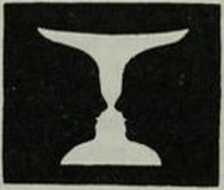
FIGURE 1
Since we shall make extensive use of the gestaltist’s concepts of figure and ground, we present several illustrative visual examples. Figure 1 is a well-known textbook example of the figure-ground phenomenon. In this drawing the figure may be seen as a white chalice on a black ground; or, if the white area be taken as ground, then the figure becomes two heads in profile silhouette. One may, upon continued inspection of this ambiguous picture, become adept at shifting from one way of organizing it to the other, but one can never organize it both ways at once. Furthermore, please note that when a change in what is seen occurs, it is not a consequence of some modification in what is “objectively” given on the printed page—that was fixed once and for all when the book went to press —but is, rather, brought about by the activity of the seeing organism. Also, notice the three-dimensional quality of the two-dimensional picture. When one sees the white figure, the black ground is behind it. Likewise, a similar depth effect occurs when the two heads are seen as if outside a lighted window.
Figure 2 again presents an ambiguous picture, this time one in which there is more detail. In glancing at this, you will probably see at once a young woman in three-quarter view to the left. On the other hand, you may be that one person in about five who immediately sees an old hag facing to the left and forward. If you do not for a time spontaneously reorganize what you first saw—that is, destroy it as such and use its parts to make the new picture— there are ways in which we can assist you, and these, essentially, are the same ways that will be employed in the experiments to follow.
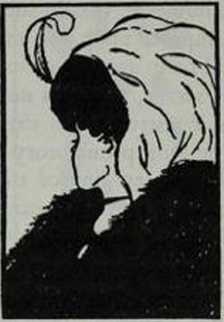
FIGURE 2
First, though, there are several important points that we can make with the situation as it stands. Unless we had told you that there was a second picture, you certainly would not have suspected it or looked for one. You would have been quite satisfied with the correctness and adequacy of what you saw at first glance. What you now see, whichever picture it is, is correct. It solves for you, in terms of the way your seeing is at the moment organized, the question of “What is this a picture of?” In the context of our present discussion of figure and ground, you are probably willing to concede that we are not trying to dupe you and that the alternative organization, if it has not by this time been achieved by you, will shortly be yours and you will see the other picture just as clearly as you now see the first one. In another context, you might regard someone who claims to see something that you do not as mistaken, or “nuts,” and pass on.
If you see a young woman where we say there is an old woman, you might, if a compliant type, decide to submit and say what we say. If we greatly outnumber you—if we, for instance, are “society” and you an “individual”—then, if you will yield and agree with us, we shall reward you by acknowledging that now you are behaving “normally.” Please note, however, that in such ease your acceptable behavior will have been imposed upon you and you will not be living it on your own. You will be in agreement with us only on a verbal basis, not on the basis of seeing, which is non-verbal.
This picture has been constructed so that various of its details have a dual function. The long promontory' which is the old hag’s nose is the whole cheek and jaw-line of the young woman. The hag’s left eye is the young woman’s left ear, her mouth the young woman’s velvet neckband or choker, her right eye a bit of the young woman’s nose, etc. If we could trace these for you it would be more helpful, but by now you probably have seen the second picture. It will have come suddenly, perhaps startling you into a little exclamation of surprise. This is what gestalt psychologists call the “aha!” experience. Their formal name for it is insight.
To give further illustration of what is meant by insight or sudden reorganization of behavior, we present Figures 3, 4 and 5. The first is “easy,” the second “harder,” and the last “very hard” for most persons, although this order by no means holds in all cases. These ae not ambiguous pictures. They are incomplete objects, with much of the detail which would ordinarily be present left out. However, the bits which are present are in their proper positions, and the work which must be done to see and name the object involves a kind of “subjective” filling in of the blank spaces in such a way, as the gestaltists put it, as to effect “closure.” Staring fixedly at what is given, or deliberate attempts to force meaning on the hodge-podge of parts, usually blocks the spontaneous process of reorganization. That this must be spontaneous, as opposed to something deliberately decided upon, is shown by the failure of any attempt to “will” to see the old hag or the young woman. Freely shifting your gaze from one part to another and taking, if you can, an attitude of eager curiosity rather than vexed impatience, is the most favorable approach. If the pictures still do not come, they will at some later time when you examine them afresh.
In the experiments to follow, when we talk of figure and ground, it may or may not be in a visual sense. We have used visual examples here because they are the only kind we can present in a book, but later we shall request you, for example, to examine bits of muscular tension which you may find here and there in your body, tinglings, itches, or even blank spots, and to see whether they will perhaps suddenly come together as a gestalt—in this case a motor gestalt which is the beginning pattern of action of something that you want to do.
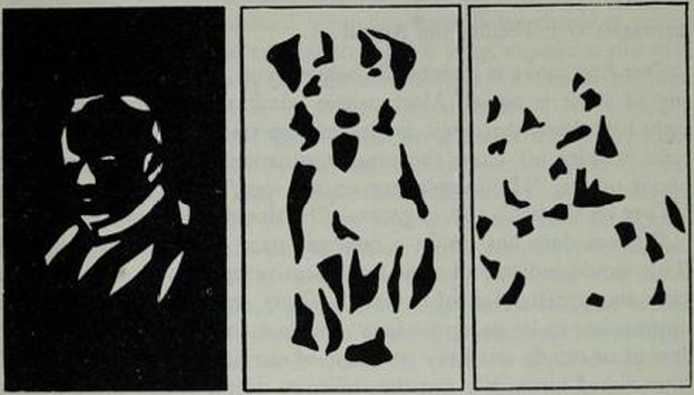
FIGURES 3, 4, 5
From Street, Roy F., Gestalt Completion Test. Bureau of Publications, Teachers College, Columbia University, 1931. Reprinted by permission of the publisher and the author.
This will be difficult, time-consuming, exasperating. When you fail to get quick results, you may abandon the whole program, condemning it as a stupid waste of valuable time, or, at the very least, complaining that the instructions should have made the work clearer, quicker and easier. These can be and will be improved. In fact, you can contribute to their improvement by reporting your difficulties to us, addressing us through our publisher. But we cannot do the work for you. Like seeing the other picture in the example given above, you must do this for yourself if it is ever to be done.
- 1. In separating this group of workers into two mutually exclusive subgroups we lay ourselves open to the same charge of “false dichotomizing” that we bring to bear against others throughout this book. Actually, psychologists as a group constitute what the statistician would characterize as a “bimodal distribution.” We are here deliberately abstracting what we regard as typical of “clinicians” and of “experimentalists” when considered as distinct and contrasting subgroups, even though we are quite aware that this distorts the case in greater or lesser degree for those many workers who occupy intermediate positions.
- 2. Many investigators acknowledge, to be sure, that in some particular study they have not managed to keep the experimenter out of the experimental picture. To the extent, however, that his presence has influenced the results, this is regarded as contamination, and attempts are then made, by statistical manipulations perhaps, to “partial out" his influence and thus purify the data.
- 3. L. L. Whyte, The Next Development in Man, Henry Holt and Company, New York, 1948.